
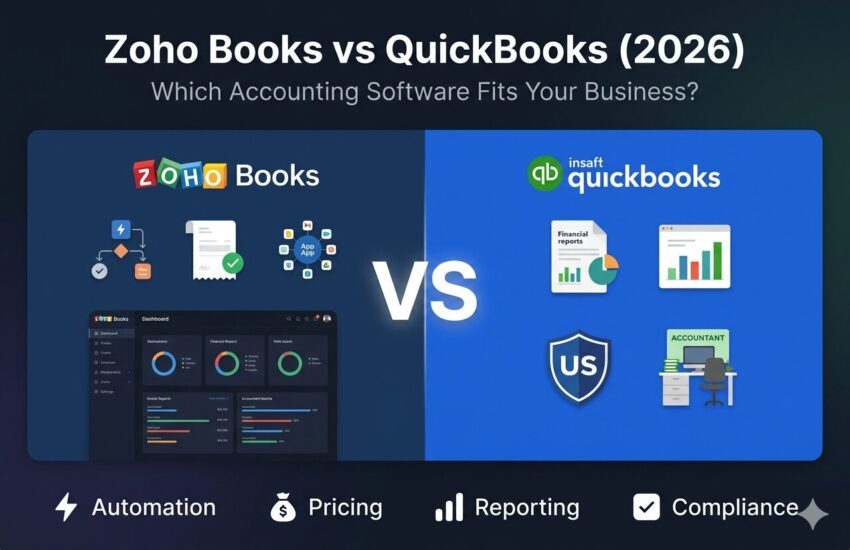
If you’ve been comparing accounting tools recently, chances are you’ve landed on this exact debate: Zoho Books vs QuickBooks. And honestly, it’s not as straightforward as it used to be.
Back in the day, QuickBooks was the obvious choice. Almost default. But now? With automation, AI-driven insights, sales tax compliance, and growing remote teams, the decision depends a lot more on how your business actually runs your structure, your stack, and your purpose.
So instead of giving you a generic comparison, let’s break this down with real use cases, real feature differences, and what actually matters in 2026.
💡 Already using Zoho products? Working with a certified Zoho Books accounting consultant can help you set up, migrate, and automate your entire financial workflow saving hours every week.
Why This Comparison Matters More in 2026
Today, accounting software is no longer just for bookkeeping. It’s now the backbone of:
- Real-time cash flow visibility
- Tax compliance — sales tax, IRS reporting, multi-state rules
- Automating repetitive financial tasks
- Integrating your CRM, eCommerce, and payment systems
If your accounting system doesn’t keep up, things start slipping. Slowly at first, then all at once. Choosing the right platform matters more than ever.
Quick Overview: Zoho Books vs QuickBooks at a Glance
| Feature | Zoho Books | QuickBooks |
|---|---|---|
| Best For | SMBs, Zoho ecosystem users | SMEs, US accountants, global users |
| Ease of Use | Clean, modern UI | Requires initial familiarity |
| Pricing | More affordable | Higher, especially with add-ons |
| Sales Tax Compliance (US) | Good (with setup) | Strong native support |
| Automation Workflows | ⭐ High — intuitive & customizable | Moderate |
| Third-Party Integrations | Best within Zoho ecosystem | Wider mixed-tool ecosystem |
| AI Insights (2026) | Growing fast | More mature |
| Advanced Financial Reporting | Good for most SMBs | ⭐ Stronger & deeper |
Zoho Books: Built for Automation-First Businesses
Zoho Books has quietly evolved into one of the most powerful accounting platforms for small and mid-sized businesses. Not flashy, just efficient, connected, and built for modern workflows.
✅ What Works Really Well
- Strong sales tax tracking and automation
- Seamless integration with the entire Zoho ecosystem
- Custom workflow automation rules that save hours
- Clean, modern interface — faster onboarding
- Highly cost-effective for growing businesses
⚠️ Where It Falls Short
- Fewer third-party integrations vs QuickBooks
- Can feel restrictive outside the Zoho ecosystem
- Reporting less deep for advanced accounting needs
Once you set up Zoho Books automation rules, things just click. Invoices get triggered. Reminders go out. Reports generate automatically. You stop “doing accounting” your system handles it for you.
And if you’re already using Zoho CRM, Zoho Inventory, or Zoho Analytics, Zoho Books becomes an absolute powerhouse of connected financial intelligence. Speaking of which — if you’re in eCommerce, you’ll want to read about the 10 powerful Zoho Analytics use cases for eCommerce businesses to see how deeply these tools integrate.
QuickBooks: Still the Industry Standard
QuickBooks still dominates the US market — and for good reason. It’s reliable, widely accepted by accountants, and backed by decades of trust. But in 2026, it’s also trying to catch up in some key areas.
✅ What It Does Best
- Rock-solid accounting foundation
- Advanced financial reporting and forecasting
- Huge ecosystem of third-party integrations
- Widely accepted by US accountants and finance teams
- Strong native multi-state and international compliance
⚠️ Where It Feels Outdated
- UI feels slightly dated compared to modern tools
- Pricing scales quickly with features and users
- Automation isn’t as intuitive as Zoho’s
- May need additional tools for workflow automation
If your business relies heavily on external accountants, detailed financial reporting, or established US accounting processes, QuickBooks still has a clear edge.
Feature-by-Feature Comparison That Actually Matters
Let’s go beyond the surface specs and compare the features that impact your day-to-day operations.
1. Efficiency & Automation
✅ Zoho Books — Winner
- Advanced custom workflow automation
- Auto-triggered invoices, reminders, reports
- Reduces manual data entry significantly
- Rule-based automation with zero coding
QuickBooks
- More manual control over processes
- Automation available but less intuitive
- May require third-party tools (Zapier, etc.)
2. Integrations & Ecosystem
Zoho Books — Best in Zoho
- Native integration with Zoho CRM, Inventory, Analytics
- One unified dashboard for your entire business
- Best for Zoho-first businesses
✅ QuickBooks — Wider Ecosystem
- Connects with 700+ third-party tools
- Better for mixed-tool environments
- Extensive marketplace of plugins
3. Pricing & Value
Zoho Books is noticeably more affordable, especially for small businesses. QuickBooks is powerful, but the pricing increases significantly as you scale, particularly when you add users or unlock advanced features. For budget-conscious businesses, Zoho Books delivers considerably more value per dollar.
4. US Tax Compliance
QuickBooks has stronger native handling for US accounting standards, IRS reporting, and multi-state sales tax rules. Zoho Books supports US sales tax well, but may require more initial setup depending on your state. If US compliance is your #1 priority, QuickBooks has a built-in advantage.
5. Financial Reporting & Depth
QuickBooks leads here with more advanced reports, deeper forecasting tools, and richer financial insights critical for businesses that rely on detailed financial data. Zoho Books reporting is good enough for most SMBs, but may fall short for complex, multi-entity needs.
💡 Pro Tip: If you’re using Zoho Books for eCommerce, pair it with Zoho Analytics for powerful business intelligence. Check out the top Zoho Analytics use cases for eCommerce data analysis to understand the full potential of the Zoho financial stack.
So, Which One Should You Choose?
Most blog posts give a generic answer here. Let’s be specific instead.
✅ Choose Zoho Books If You…
- Want automation over manual processes
- Run a small to mid-sized business
- Need a cost-effective accounting solution
- Already use Zoho CRM, Inventory, or Analytics
- Want a clean, modern interface with fast onboarding
- Are building an eCommerce or SaaS business
✅ Choose QuickBooks If You…
- Work closely with US-based accountants
- Need advanced financial reporting
- Operate across multiple US states or internationally
- Rely on multiple third-party tools
- Need deep IRS compliance capabilities out-of-the-box
Real-World Scenario: Which Would You Choose?
📦 Scenario A — Growing eCommerce Brand
Orders from Shopify. CRM in Zoho. Multi-channel sales. Sales tax across multiple states.
➡️ Zoho Books wins — the automation, native CRM integration, and connected Zoho ecosystem make it the natural fit. A professional Zoho Books setup and migration service can get you fully operational fast.
🏢 Scenario B — US-Based Consulting Firm
Works with US accountants. Needs detailed financial reports. Multiple client entities.
➡️ QuickBooks wins — its deeper reporting, accountant-friendly interface, and strong US compliance tools are the right fit here.
The Bottom Line
The gap between these two tools is becoming more interesting every year. On one side, you have a platform built around structure, control, and deep financial visibility. On the other, a system engineered for automation, speed, and connected business workflows.
Businesses today aren’t just looking to “manage accounts.” They want systems that reduce manual work, connect with their tech stack, and deliver real-time financial clarity — without extra effort.
That’s where Zoho Books feels naturally aligned with modern operations. At the same time, QuickBooks continues to hold strong ground, especially for businesses that rely on accountants, detailed reporting, and established financial processes.
So instead of asking which tool is “better,” ask yourself: Does your business need more control or more efficiency?
Need Help Choosing or Migrating?
Still unsure, or planning to switch from QuickBooks to Zoho Books? Working with an experienced consultant saves time and prevents costly mistakes.Talk to a Zoho Books Consultant →

:%20Which%20Accounting%20Software%20Actually%20Fits%20Your%20Business?&media=https://erpocean.com/wp-content/uploads/2025/11/Zoho-Books-vs-QuickBooks-2026-comparison-best-accounting-software-for-small-business.jpg)