
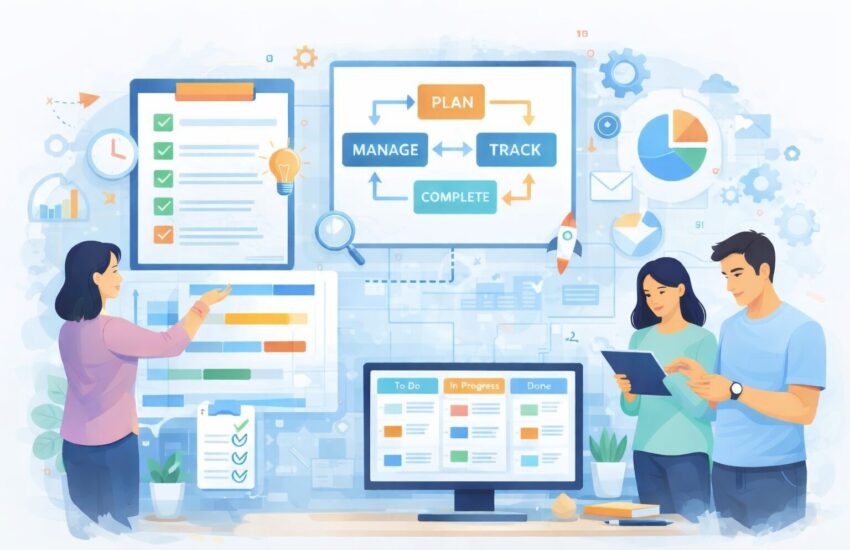
In today’s fast-paced business environment, organizations must deliver projects faster, smarter, and with fewer resources. This is where project management plays an important role. Project management makes sure that work is planned, executed, and delivered successfully,y whether it is launching a new product or the successful implementation of enterprise software.
But when you ask yourself what project management is, this guide tells you all you have to know about it, such as the definition, relevance, benefits, processes, techniques, and the role of modern project management software in making predictable outcomes.
What Is Project Management?
Project Management Definition
A project manager has the responsibility of leading a project through to the end and making sure that it is aligned with business objectives. It ensures that the resources (people, time, money, and tools) are used in an effective way so that effective and quantifiable results are achieved. Companies can reduce risks and track complicated projects through established practices and procedures.
To put it in simple terms, when you pose a question to yourself about what project management is like, it is the process of changing ideas, strategies, and business objectives into their completed results.
What Does a Project Manager Do?
A project manager has the duty of leading a project to its completion and also being able to align it with the business objectives. This is a particularly important role during project management within a company where several teams, priorities, and deadlines overlap.
Key Responsibilities of a Project Manager
- Defines project goals, scope, and success parameters
- Organizes activities, schedules, and budgets.
- Delegates duties to groups and individuals.
- Defines project goals, scope, and success parameters.
- Manages risks, dependencies, and unexpected issues
- Delivers projects on time and on a budget.
The answer to what a project manager does is the reason why good leadership and coordination are the keys to the success of a project.
Significance of Project Management in Today’s Business Environment
Project management is no longer a decision, but a strategic requirement. Project management becomes even more relevant to organizations as they become more complex.
The Importance of Project Management
- Maintaining project compatibility with the business goals
- Eliminates scope creep and budget overruns.
- Improves collaboration and accountability
- Improves customer and stakeholder satisfaction
- Enables better decision-making of data and reporting.
Without having a structured project management, the teams will fail not only to meet their deadlines, but also squander resources and irregular outcomes.
Project Management Process: Step-by-Step
A typical project management process offers a repeatable model of delivering successful projects. Although the methodologies can be different, the majority of projects have five major stages.
1. Initiation
- Identify project deliverables and performance measures.
- Evaluate viability, worth, and limitations.
- Define key stakeholders and expectations
2. Planning
- Divide work into milestones and tasks.
- Make time schedules, budgets, and programs.
- Determine risks, dependencies, and mitigation strategies
3. Execution
- Assign tasks to teams
- Coordinate people, tools, and resources
- Enforce effective communication among stakeholders.
4. Monitoring & Controlling
- Track project using project tracker software.
- Evaluate the performance based on the KPIs and milestones.
- Adjust plans to manage changes or risks
5. Closure
- Deliver the final output
- Review outcomes against objectives
- Record lessons to be employed in future projects.
The use of systematic project management decreases the rate of failure and enhances predictability.
Advantages of Project Management.
The benefits of project management extend across teams, departments, and entire organizations.
Key Benefits
- Clearness and improved organization.
- Better productivity and efficiency.
- Low risks, mistakes, and rework.
- Better cooperation and communication.
- Consistent delivery of results
- Higher return on investment (ROI)
Such benefits are even more effective when justified with the help of the appropriate project management tools and software.
For businesses looking to streamline HR and task management, this guide on why Weekmate is the smart choice for HRMS highlights how integrated tools enhance productivity and team collaboration
Techniques of Project Management.
Various projects have varied approaches. The selection of the appropriate project management techniques is dependent on industry, project size, and the organization of the team.
Common Project Management Techniques
- Waterfall – Linear, sequential approach ideal for fixed-scope projects
- Agile – iterative and dynamic, most appropriate in changing requirements.
- Scrum – Agile framework is sprint and team-oriented.
- Kanban – Visual workflow management for continuous delivery
- Lean Project Management – Removes waste and enhances efficiency
Knowing these methods assists organizations in personalizing their approach in order to be most effective.
Project Management Tools Explained
What Are Project Management Tools?
Project management tools refer to online tools used to plan, monitor, and manage projects effectively. They integrate activities, channels of communication, schedules, and reporting in one platform. Project management software is very important in modern teams to cope with the complexity and size of operations.
Types of Project Management Tools
- Task management software – Manages individual tasks, priorities, and assignments
- Project tracker software – Monitors timelines, milestones, and progress.
- Project management software – All-in-one platforms for planning, execution, collaboration, and reporting
Weekmate TaskHub is a practical task management software that helps teams organize tasks, track progress, and collaborate efficiently from a single, centralized workspace.
Advantages of Project Management Software
The advantages of project management software make it important for modern businesses.
Key Advantages
- Visibility of all projects centrally.
- Live cooperation and communication.
- Task reminders and trackers that are automated.
- Improved time and resource management
- Data-driven insights and reporting
- Less manpower and fewer mistakes.
That is why more and more organizations use the help of advanced tools in project management in order to remain competitive.
Why Businesses Need Project Management Software
As teams become distributed and projects become more complex, manual tracking methods are no longer sufficient.
How Project Management Software Helps Businesses
- Maintains focus and performance of teams.
- Assures interdepartmental transparency
- Enhances accountability and tracking of performance.
- Supports remote and hybrid work environments
- Grows well as projects expand.
Concisely, project management software changes the way teams plan, work and deliver outcomes.
Comparative Table of Project Management Tools.
| Feature | Task Management Software | Project Tracker Software | Project Management Software |
| Task Assignment | Yes | Yes | Yes |
| Timeline & Milestones | Limited | Yes | Advanced |
| Resource Management | No | Limited | Yes |
| Reporting & Analytics | Basic | Moderate | Advanced |
| Collaboration Tools | Basic | Limited | Real-time |
| Best For | Small teams | Tracking progress | End-to-end project control |
Conclusion
Proper project management is a key to attaining business objectives effectively and continuously. An organised project management process, backed up by current project management software, assists the teams to complete their projects on time and within budget and with quantifiable effects.
Organizations can be better controlled through investing in the right task management software or the project tracker software, and this ensures that collaborating becomes much easier and therefore the organization has a good competitive edge in the current dynamic business world.
Frequently Asked Questions (FAQs)
1. What is project management mean?
Project management is a process of planning, organizing, and completing work to achieve set goals within time and financial constraints.
2. What does a project manager do on a day-to-day basis?
A project manager will schedule the work, monitor the work progress, communicate with the stakeholders, manage risk management, and keep the projects within the timeline and budget.
3. What is the importance of project management to businesses?
The outcomes of project management are efficiency, reduction of risks, enhanced cooperation, and delivering the business objectives in a systematic way.
4. What are the key advantages of project management software?
The main advantages are the centralized visibility, real-time collaboration, automated tracking, enhanced resource management, and making decisions based on data.
5. What are the most appropriate project management tools?
The tools should be chosen based on the scale of the project, the formation of the team, the required features, scalability, and compatibility with the existing systems.

