
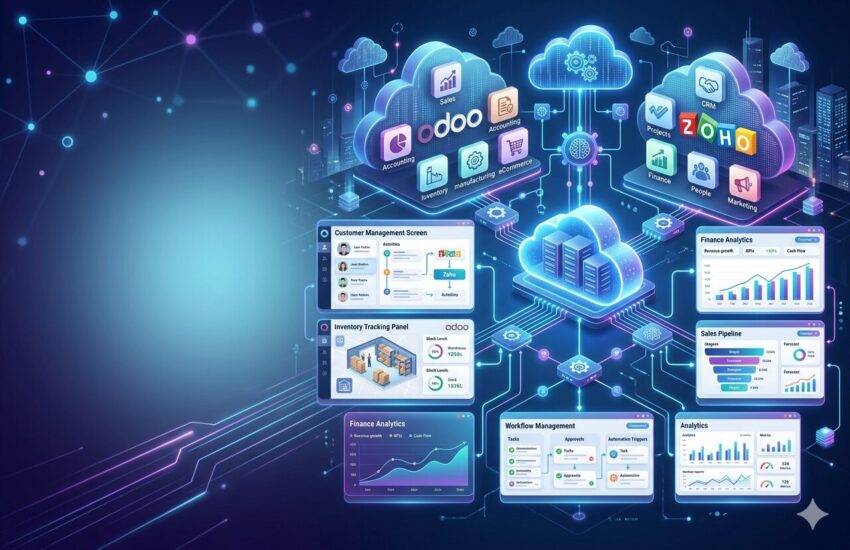
Businesses running on outdated, fragmented software are falling behind. Not always in obvious ways. Sometimes it’s just a sales team that doesn’t know what the warehouse knows, or a finance report that’s already three days old by the time anyone reads it.
Cloud ERP is what fixes that. And in 2026, calling it a “strategic choice” almost undersells it. It’s closer to basic infrastructure at this point.
What Is ERP Software?
Here’s the simplest way to think about it. ERP connects the parts of a business that usually operate in silos. Finance, sales, inventory, HR and supply chain in one platform. There’s just one shared source of data. No more chasing the operations team for numbers that should already be in the system.
Traditional ERP ran on local servers. It needed dedicated hardware, a capable IT team, and often months of painful setup. For most mid-sized businesses, that was never a realistic option. Cloud ERP removes all of that overhead, which is a bigger deal than it might sound.
Why Cloud ERP Makes Sense in 2026?
Remote and Hybrid Work Is Permanent
The office-only model is gone, and it’s not coming back. Teams work from home, from different cities, sometimes different countries. An ERP system that only works on-site is a bottleneck.
Cloud ERP means the warehouse manager and the remote finance head are looking at the same live numbers, from wherever they happen to be. That kind of visibility used to be hard to get. Now it’s just expected.
AI and Automation Are Now Table Stakes
This is where things have genuinely shifted. Modern cloud ERP platforms like Odoo and Zoho don’t just store data. They act on it. You’ll notice the difference almost immediately when you see things like:
- Automated lead assignment and follow-ups
- Demand forecasting that learns from historical patterns
- Workflow automation across departments
- Customer behavior insights built directly into the CRM
Manual approval chains or repetitive data entry, most of that can be automated away. And honestly, it should be.
Lower Cost, Faster Go-Live
Traditional ERP implementations dragged on for 12 to 18 months. Cloud ERP, especially modular platforms with proper Odoo implementation services, can go live in weeks.
No hardware purchases, no server rooms, no large IT team on retainer. For businesses that previously looked at ERP and thought “we can’t afford this,” the math has changed.
It Scales With the Business
Ten employees today, two hundred next year. Cloud ERP handles that shift without forcing a full re-implementation every time the business grows. New users, new modules, new office locations: it all layers in without major infrastructure work. So growth doesn’t mean starting over.
Security and Compliance Are Built In
Most businesses simply can’t match what enterprise cloud providers invest in security. And they shouldn’t have to. Standard cloud ERP features now include:
- End-to-end encryption
- Role-based access controls
- Automated backups
- Continuous threat monitoring
For companies handling financial data or customer records across remote teams, this isn’t a bonus feature. It’s the baseline expectation.
Real-Time Data, Not Yesterday’s Report
Weekly spreadsheets compiled by the finance team are a slow way to run a business. Cloud ERP provides live dashboards covering revenue, pipeline, inventory, and operations. When something shifts, leadership sees it right away. Not at the next Monday check-in, not after someone updates a shared file. Right away.
Key Trends Shaping Cloud ERP in 2026
1. ERP and CRM Are Merging
Here’s the thing about running separate CRM and ERP tools, the gaps are constant. Data doesn’t sync properly. Sales doesn’t have visibility into finance. Finance can’t see the pipeline clearly.
Integrated platforms like Odoo (ERP plus CRM) or Zoho (CRM plus Zoho Books) eliminate that middle layer. Customer data, sales records, and financial reporting all live together. It sounds simple, but the difference in day-to-day operations is significant.
2. Low-Code Customization Is Standard
Customizing ERP used to mean bringing in developers for every workflow change. That was slow and expensive. Most cloud platforms now let operations teams handle a lot of it themselves:
- Build and modify workflows without writing code
- Set up automation rules
- Create custom dashboards
- Connect third-party apps
Less dependency on developers for every small adjustment. Faster changes when the business needs them.
3. AI Is Shifting From Feature to Foundation
Forecasting, anomaly detection, inventory optimization, or sales predictions aren’t optional add-ons anymore. They’re being built into the core of modern ERP platforms.
And the businesses getting the most value aren’t just using ERP to record what already happened. They’re using it to anticipate what’s coming next. That’s a meaningful shift in how these tools are actually used.
4. Industry-Specific Modules Are Reducing Implementation Time
Generic ERP platforms used to require significant customization just to fit a specific industry. Pre-built modules for manufacturing, retail, healthcare, logistics, and professional services now come ready to deploy. Less setup friction, better fit from day one.
5. SMEs Now Have Access to Enterprise-Grade Tools
This one is worth paying attention to. Subscription pricing and modular structures have made cloud ERP adoption realistic for businesses that would have been priced out of traditional systems entirely.
Odoo implementation services, for example, are now accessible at early growth stages, not just for large enterprises with large IT budgets. That’s a real change in who can compete.
Cloud ERP vs. Traditional ERP
|
Feature |
Cloud ERP |
Traditional ERP |
|
Deployment |
Hosted on cloud servers |
Hosted on local servers |
|
Upfront cost |
Low |
High (hardware + setup) |
|
Scalability |
Add users and modules easily |
Requires infrastructure upgrades |
|
Accessibility |
Any device, anywhere |
On-premise only |
|
Automation |
AI-powered, built-in |
Limited |
|
Updates |
Automatic |
Manual and time-consuming |
|
Best for |
SMEs, growing businesses |
Large enterprises with dedicated IT |
The ERP Implementation Process
Switching to cloud ERP doesn’t have to be a nightmare. But skipping steps almost always makes it one. Here’s how a solid ERP implementation process typically looks:
- Requirement analysis — Understand what the business actually needs before picking a platform
- Platform selection — Compare options like Odoo or Zoho against industry fit, budget, and required modules
- Process mapping and customization — Configure the system around how the business actually operates, not the other way around
- Data migration — Move existing data carefully; this step gets underestimated almost every time
- Integrations — Connect ERP with eCommerce, payroll, logistics, and existing tools
- User training — Adoption fails without it, consistently
- Testing and go-live — Run both systems briefly before fully cutting over
- Ongoing optimization — ERP gets better the more it’s used and refined over time
Odoo’s modular structure makes this more manageable than most. Start with the modules that matter most, and expand from there.
Final Thoughts
Cloud ERP isn’t a future investment anymore. The implementation timelines are manageable. What’s left is the decision.
If cloud ERP is something you’re seriously considering, don’t let the research phase stretch into inaction. Get a proper consultation.
Talk to an ERP specialist today and see what a cloud-based system could look like for your business.
Frequently Asked Questions
What does ERP software actually do?
It connects the core business functions into one system. Less manual work, fewer errors, and much better visibility across the whole operation.
Why is cloud ERP better than traditional?
Lower startup cost, faster implementation, accessible from anywhere, and it updates automatically. Traditional ERP requires hardware and IT investment. Most businesses can’t realistically sustain that long-term.
How do Odoo and Zoho fit into this?
Odoo is modular and highly customizable. It’s a good fit for SMEs that want to start focused and grow into the platform over time. Zoho offers strong CRM automation through its Zoho CRM features and integrates naturally with its own finance and operations tools.
Which industries benefit the most?
Manufacturing, retail, logistics, healthcare, and e-commerce see the clearest impact. High transaction volumes and compliance requirements all benefit from cloud ERP automation.
How long does a cloud ERP implementation take?
A focused Odoo implementation for a small or mid-sized business can go live in four to eight weeks. Larger deployments take longer. But the timeline is rarely as long as traditional on-premise projects used to.

